YITAHOME vs Cozeware: Mini Splits Compared by Specs
As an Amazon Associate we earn from qualifying purchases. Links on this page are affiliate links.
In this YITAHOME vs cozeware mini split comparison, you see two 12,000 BTU units with identical 20 SEER2 efficiency ratings. Both models use inverter technology and offer Wi-Fi smart control for remote operation. The main difference lies in their electrical requirements. One unit operates on a standard 115V circuit, while the other requires a 230V connection. This voltage distinction dictates which home wiring can support each system.
Key differences
| Aspect | YITAHOME 12000 BTU 115V Mini Split | Cozeware 12000 BTU 230V Mini Split |
|---|---|---|
| Voltage | 115V | 230V |
| Coverage Area | 750 sq ft | not listed |
| Smart Control | Wi-Fi, Alexa | Wi-Fi, Voice Control, Cozeware APP |
| Indoor Unit Weight | 22 pounds | 72.1 pounds |
Which one should you choose?
Choose YITAHOME 12000 BTU 115V Mini Split if
- You have a standard 115V outlet and want a lighter indoor unit.
- You prefer direct Alexa integration without a dedicated app.
- You need a stated coverage area of 750 sq ft.
Choose Cozeware 12000 BTU 230V Mini Split if
- You have a 230V circuit available for higher power stability.
- You want a dedicated Cozeware APP for detailed settings.
- You value a lower sleep mode noise level of 31 dB.
Verdict: Choose the YITAHOME model if your home wiring supports 115V and you want a lighter, simpler unit with Alexa support. Pick the Cozeware option if you have a 230V circuit and prefer a dedicated app with more granular control options.
YITAHOME vs Cozeware Mini Split Specs
Voltage compatibility
Your electrical setup dictates which unit fits your home. The YITAHOME 12,000 BTU model operates on 115V power. This standard voltage allows for easier installation in many residential settings without requiring specialized high-voltage circuits. The Cozeware 12,000 BTU unit requires 230V. This higher voltage is common in newer homes or dedicated circuits but may need an electrician to upgrade your panel. If you have a standard 115V outlet, the YITAHOME option is the straightforward choice. The Cozeware model demands a 230V line, which adds complexity if your home lacks that infrastructure.
Noise levels
Quiet operation matters for bedrooms and living spaces. The Cozeware mini split features a dedicated sleep mode that reduces noise to 31 dB. This whisper-quiet performance ensures undisturbed rest during the night. The YITAHOME unit runs at under 41 dB. While still relatively quiet, it is noticeably louder than the Cozeware model. The 10 dB difference is significant in a quiet room. If you prioritize silence for sleeping or working, the Cozeware unit offers a clear advantage with its lower decibel rating. The YITAHOME model remains acceptable for general use but lacks the ultra-quiet sleep mode specification.
Smart features
Both units offer Wi-Fi connectivity for remote control. The Cozeware system includes a dedicated app for hands-free voice control and remote adjustments. This provides a centralized interface for managing your climate settings from anywhere. The YITAHOME unit also supports Wi-Fi and Alexa compatibility. However, the data does not explicitly mention a proprietary app for YITAHOME, relying instead on third-party voice assistants. If you prefer a branded app experience alongside voice commands, the Cozeware option is more comprehensive. The YITAHOME model is sufficient if you already use Alexa for home automation.
Fan speeds
Airflow control affects comfort and energy use. The Cozeware mini split provides seven distinct fan speeds. This range allows you to fine-tune airflow from a gentle breeze to strong cooling. The YITAHOME unit offers four fan speeds. This includes low, medium, high, and turbo settings. While adequate for most needs, the Cozeware model provides more granular control over air circulation. If you prefer precise adjustments for varying comfort levels or noise preferences, the Cozeware seven-speed system is superior. The YITAHOME four-speed option is standard but less flexible.
Warranty coverage
Long-term protection is a key specification. The Cozeware unit includes a 5-year replacement coverage for parts and a 7-year replacement coverage for the compressor. This extended warranty provides peace of mind for major components. The YITAHOME data does not list specific warranty terms. Without explicit warranty information in the provided specs, you cannot compare the protection levels directly. The Cozeware model offers documented, lengthy coverage for critical parts. This is a significant advantage for long-term ownership costs and reliability assurance.
Which Mini Split Suits Your Home Best
Renters with standard outlets
You need a unit that plugs into a standard 115V outlet. The YITAHOME model uses 115V power, making it easier to install in homes without dedicated high-voltage circuits. This voltage compatibility simplifies setup for apartments or condos where electrical upgrades are not an option. It delivers 12,000 BTU cooling with 20 SEER2 efficiency.
Users wanting app control
You prefer managing your climate through a dedicated smartphone application. The Cozeware system includes an exclusive Cozeware APP for remote temperature adjustments and mode switching. This offers more granular control than the YITAHOME remote or Alexa integration. You can also use voice commands via WiFi. The 230V connection supports this advanced smart infrastructure.
Sleepers needing quiet operation
You prioritize silence during nighttime hours. The Cozeware unit drops to 31 dB in sleep mode, which is significantly quieter than the YITAHOME model’s 41 dB rating. This lower noise level ensures undisturbed rest. Both units offer 12,000 BTU capacity and 20 SEER2 efficiency, but the Cozeware’s quieter performance makes it better for bedrooms or light sleeping environments.
The products compared

YITAHOME 12000 BTU 115V Mini Split
Best for: 115V homes needing cold-climate heating
- Cooling Capacity
- 12000 BTU
- Efficiency Rating
- 20 SEER2
- Voltage
- 115V
- Coverage Area
- 750 sq. ft.
- Heat Pump
- Heat pump
- Smart Connectivity
- Wi-Fi, Alexa
View on Amazon: YITAHOME 12000 BTU 115V Mini Split Affiliate link
This YITAHOME unit delivers 12,000 BTU of cooling and heating for spaces up to 750 square feet. It achieves a 20 SEER2 efficiency rating, which reduces energy use compared to lower-rated models. The system includes Wi-Fi connectivity for remote control and Alexa compatibility. It operates quietly at under 41 dB and functions in temperatures ranging from 5°F to 118°F. This setup suits those seeking a versatile, energy-efficient climate solution for medium-sized rooms.
Pros
- 20 SEER2 efficiency rating for lower energy consumption
- Wi-Fi and Alexa smart control capabilities
- Quiet operation at under 41 dB
- Heating performance down to 5°F outdoor temperature
Cons
- 115V voltage limits compatibility with some electrical setups
- No dedicated mobile app mentioned in specifications
- Display brightness cannot be adjusted via remote
Good fit if
- You need a heat pump that works in cold weather down to 5°F
- You want Wi-Fi control without relying on a separate app
- You are cooling a single room up to 750 square feet
Skip if
- You require a 208-230V connection for your installation
- You need a unit larger than 12,000 BTU
- You prefer a system with a dedicated smartphone app
Verdict: YITAHOME 12000 BTU Mini Split offers strong cold-weather heating and high efficiency for standard 115V circuits. It fits users who prioritize quiet operation and basic smart controls over advanced app features.
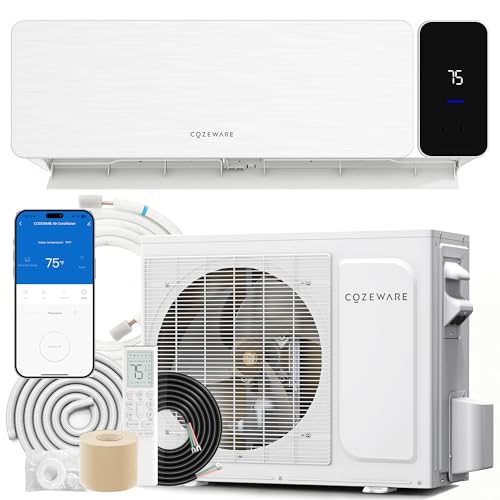
Cozeware 12000 BTU 230V Mini Split
Best for: 230V-powered quiet rooms
- Cooling Capacity
- 12,000 BTU
- Efficiency Rating
- 20 SEER2
- Voltage
- 230V
- Coverage Area
- Up to 750 sq ft
- Smart Connectivity
- WiFi, App control
- Smart Control
- Wi-Fi
View on Amazon: Cozeware 12000 BTU 230V Mini Split Affiliate link
This Cozeware mini split offers 12,000 BTU cooling and heating via a 230V circuit. It achieves 20 SEER2 efficiency and includes built-in WiFi with app and voice control. The unit features 4D air swing, seven fan speeds, and operates as quietly as 31dB in sleep mode. It comes with a classic remote and five-year parts warranty. This system suits medium-to-small rooms needing smart control and quiet operation.
Pros
- 20 SEER2 efficiency rating for energy savings
- Built-in WiFi with Cozeware app and voice control
- Ultra-quiet 31dB operation in sleep mode
- 4D air swing for multi-directional airflow
- Five-year replacement coverage for parts
Cons
- Requires 230V electrical circuit
- Heavier at 72.1 pounds
- Labor costs not covered by warranty
Good fit if
- You have a 230V outlet available
- You want smart app and voice control
- You need quiet operation for bedrooms
Skip if
- You only have 115V outlets
- You need a larger 18,000 BTU unit
- You want full labor warranty coverage
Verdict: Cozeware 12000 BTU 230V Mini Split provides solid efficiency and smart features for users with 230V power, making it a strong option for bedrooms or small offices where quiet performance matters.
Specifications side by side
| Spec | YITAHOME 12000 BTU 115V Mini Split | Cozeware 12000 BTU 230V Mini Split |
|---|---|---|
| Cooling Capacity | 12000 BTU | 12,000 BTU |
| Efficiency Rating | 20 SEER2 | 20 SEER2 |
| Voltage | 115V | 230V |
| Coverage Area | 750 sq. ft. | Up to 750 sq ft |
| Heat Pump | Heat pump | not stated |
| Smart Connectivity | Wi-Fi, Alexa | WiFi, App control |
| Smart Control | Wi-Fi, Alexa | Wi-Fi |
| Dimensions | 7.9 × 31.2 × 11.5 inches | 7.91 × 31.7 × 10.9 inches |
| Weight | 22 pounds | 72.1 pounds |
| Color | White | White |
| Model | MAYIH4qu0k | MACozewareQae6Q |
| Size | not stated | 12000 BTU 230V |
Frequently asked questions
Which mini split is better for cold climates?
The YITAHOME 12,000 BTU model is better for cold climates. It operates on 115V power, which fits standard home circuits. This unit offers strong cold-weather heating performance. You get high efficiency with a 20 SEER2 rating. The Cozeware unit requires 230V power, limiting where you can install it. If you need reliable heating in winter, the YITAHOME choice is more versatile for typical homes.
Do both units have Wi-Fi control?
Yes, both mini splits include Wi-Fi smart control. This feature lets you manage the temperature remotely from your phone. You can adjust settings without needing a physical remote nearby. The YITAHOME model provides this connectivity alongside its 115V operation. The Cozeware unit also supports Wi-Fi for convenient remote management. This shared feature ensures you can monitor your indoor climate from anywhere.
What is the weight difference between the two?
The Cozeware unit is significantly heavier than the YITAHOME model. The Cozeware 12,000 BTU unit weighs 72.1 pounds. The YITAHOME 12,000 BTU unit weighs only 22 pounds. This large difference affects installation requirements and mounting needs. You should consider the weight when planning your wall mount. The lighter YITAHOME unit may be easier to handle during setup.
Can I use the Cozeware unit on a standard outlet?
No, you cannot use the Cozeware unit on a standard outlet. It requires 230V power to operate. Standard household outlets typically provide 115V electricity. You need a dedicated high-voltage circuit for the Cozeware model. The YITAHOME unit works with 115V power, fitting standard outlets. Check your electrical panel before choosing the Cozeware option to ensure you have the right voltage.
How wide are the indoor units?
The indoor units have similar widths but are not identical. The YITAHOME unit measures 31.2 inches wide. The Cozeware unit measures 31.7 inches wide. Both fit within standard wall spaces for mini splits. The Cozeware unit is slightly wider by half an inch. You should measure your installation space to ensure both units fit comfortably. The difference is minor but relevant for tight spaces.
Which model is more energy efficient?
Both models share the same energy efficiency rating. They both achieve a 20 SEER2 efficiency rating. This means they use electricity at the same optimal rate. You get identical efficiency performance from either brand. The difference lies in voltage compatibility, not energy use. You can choose based on your power source without worrying about efficiency disparities. Both units deliver strong performance for their 12,000 BTU capacity.