COSTWAY vs Cozeware: Mini Splits Compared by Specs
As an Amazon Associate we earn from qualifying purchases. Links on this page are affiliate links.
This COSTWAY vs cozeware mini split comparison looks at two heat pump options with different capacities and features. Both units offer 20 SEER2 efficiency and 230V power for strong performance. The main difference lies in cooling power and smart controls. The COSTWAY Blast Pro delivers 18,000 BTUs and includes voice assistant compatibility. The Cozeware system provides 12,000 BTUs with a focus on quiet operation and extended warranty coverage. You should choose based on your room size and control preferences.
Key differences
| Aspect | COSTWAY Blast Pro 18000 BTU 230V | Cozeware 12000 BTU 230V Mini Split |
|---|---|---|
| Cooling Capacity | 18,000 BTU | 12,000 BTU |
| Coverage Area | Up to 1250 sq.ft. | Not listed |
| Smart Control | Wi-Fi, App, Alexa, Google Assistant | Wi-Fi, App, Voice Control |
| Noise Level | 28 dB | 31 dB |
| Warranty | Not listed | 5-year parts, 7-year compressor |
| Fan Speeds | 8 speeds | 7 speeds |
Which one should you choose?
Choose COSTWAY Blast Pro 18000 BTU 230V if
- You need to cool a larger space up to 1250 sq.ft.
- You want to use voice commands with Alexa or Google Assistant
- You prefer the quietest possible indoor operation at 28 dB
Choose Cozeware 12000 BTU 230V Mini Split if
- You are installing the unit in a smaller room or studio
- You prioritize longer warranty coverage for parts and compressor
- You want a system with multiple ECO modes for energy saving
Verdict: The COSTWAY Blast Pro is better for larger rooms and users who want direct voice assistant integration. The Cozeware 12000 BTU model suits smaller spaces and those who value extended warranty protection. Both offer efficient 20 SEER2 performance for year-round comfort.
COSTWAY vs Cozeware Spec Comparison
Cooling Capacity
The COSTWAY Blast Pro offers 18,000 BTU of cooling power, while the Cozeware unit provides 12,000 BTU. This difference matters for your room size. The higher output from COSTWAY helps cool larger spaces up to 1,250 square feet. Cozeware targets medium-to-small areas like bedrooms or small offices. If you need to chill a big open room, the extra 6,000 BTU from COSTWAY makes a noticeable difference in speed and consistency. Cozeware is sufficient for tighter spaces but may struggle in larger areas during peak heat.
Efficiency Rating
Both units share the same 20 SEER2 efficiency rating. This means they use energy at a similar rate for the amount of cooling they produce. Neither has a clear advantage here. You get the same level of energy savings from either model. The COSTWAY Blast Pro adds an ECO mode to reduce power further, but the base efficiency numbers are identical. Cozeware also lists three independent ECO modes. Since the core SEER2 rating is the same, your electricity usage per hour of operation will be comparable, assuming similar runtime and conditions.
Smart Control
Both mini splits include Wi-Fi connectivity and app control. The COSTWAY Blast Pro supports voice commands with both Alexa and Google Assistant. Cozeware also offers voice control and its own exclusive app. You can manage both units remotely from anywhere. The COSTWAY unit includes a standard remote for local control. Cozeware also provides an infrared remote. The smart features are nearly equivalent. You get app access and voice integration with either choice. There is no significant gap in connectivity options between these two models.
Noise Level
The indoor unit noise levels differ slightly. COSTWAY Blast Pro operates as low as 28 dB. Cozeware drops to 31 dB in sleep mode. The 3 dB difference is small but noticeable in a quiet room. Lower decibels mean less background hum. COSTWAY has the edge for nighttime use in bedrooms. Cozeware is still quiet, but the higher number suggests slightly more audible airflow. If you are sensitive to sound while sleeping, the lower 28 dB rating on COSTWAY provides a more peaceful environment.
Voltage
Both units require 230V power. This is standard for mini splits. You need a dedicated circuit for either model. There is no difference in electrical requirements. You must ensure your home has the correct 230V outlet or breaker panel access. Both COSTWAY and Cozeware are built for this voltage. You do not need to worry about compatibility with standard residential 230V lines. The electrical setup will be the same regardless of which brand you choose.
Which mini split suits your space
You need cooling for large rooms
The COSTWAY Blast Pro delivers 18,000 BTU of cooling power. This higher capacity allows it to handle spaces up to 1,250 square feet effectively. If you are cooling a large open area or a spacious room, this extra output ensures steady temperatures. The 20 SEER2 rating maintains efficiency even at this higher capacity.
You prioritize quiet sleep environments
The Cozeware unit offers a dedicated sleep mode that lowers noise to 31 dB. While the COSTWAY model is quieter at 28 dB, the Cozeware design specifically optimizes performance for nighttime rest. This makes it a strong choice for bedrooms where you need consistent, gentle airflow without disturbing your sleep schedule.
You want longer warranty coverage
The Cozeware system includes a 5-year replacement warranty for parts and a 7-year replacement warranty for the compressor. This extended coverage provides additional peace of mind for long-term ownership. The COSTWAY listing does not specify these warranty terms, making the Cozeware option more secure for those prioritizing product protection.
The products compared

COSTWAY Blast Pro 18000 BTU 230V
Best for: large rooms needing high capacity and smart control
- Cooling Capacity
- 18,000 BTU
- Efficiency Rating
- 20 SEER2
- Voltage
- 208/230V
- Coverage Area
- Up to 1,250 sq ft
- Heat Pump
- Heat Pump
- Smart Connectivity
- Wi-Fi, App, Alexa, Google Assistant
View on Amazon: COSTWAY Blast Pro 18000 BTU 230V Affiliate link
The COSTWAY 18000 BTU Mini Split offers 20 SEER2 efficiency and covers up to 1250 sq.ft. It operates on 208/230V and includes Wi-Fi control. The unit features a 4D airflow design and runs as low as 28 dB. It provides seven modes and eight fan speeds for precise temperature management. This model suits large rooms needing strong heating down to -4℉.
Pros
- 18,000 BTU cooling capacity for large spaces
- 20 SEER2 energy efficiency rating
- Wi-Fi and app control with voice assistant support
- Operates reliably at temperatures as low as -4℉
- Quiet indoor operation at 28 dB
Cons
- Heavier indoor unit at 20.9 pounds
- Requires professional installation
- Limited to 208/230V voltage options
Good fit if
- You need cooling for areas up to 1250 sq.ft.
- You want smart control via Wi-Fi and app
- You require heating performance in cold climates
Skip if
- You only have 115V electrical outlets
- You prefer a lighter wall-mounted unit
- You need a smaller 9000 BTU capacity
Verdict: COSTWAY 18000 BTU Mini Split delivers high capacity and smart features for large rooms. It fits buyers who need strong heating and cooling performance in spacious areas.
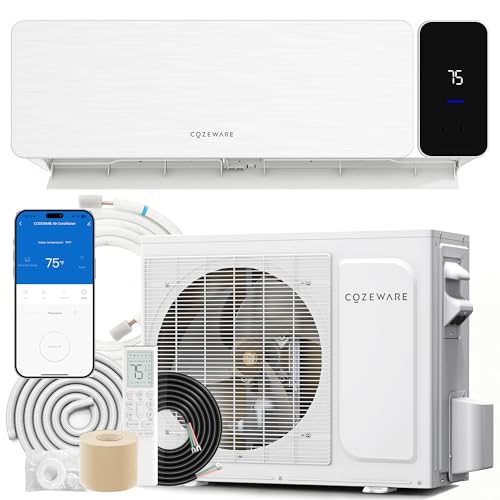
Cozeware 12000 BTU 230V Mini Split
Best for: small rooms with 230V power access
- Cooling Capacity
- 12,000 BTU
- Efficiency Rating
- 20 SEER2
- Voltage
- 230V
- Coverage Area
- Up to 750 sq ft
- Smart Connectivity
- WiFi, App control
- Smart Control
- Wi-Fi
View on Amazon: Cozeware 12000 BTU 230V Mini Split Affiliate link
This Cozeware unit delivers 12,000 BTU of cooling and heating capacity on a 230V circuit. It achieves a 20 SEER2 efficiency rating, which reduces power draw during operation. The system includes built-in WiFi for app and voice control, plus a 4D air swing for even airflow. With a sleep mode that reaches 31dB, it suits medium-to-small rooms like bedrooms or offices where quiet performance matters.
Pros
- 20 SEER2 efficiency rating for lower energy use
- Built-in WiFi with Cozeware APP and voice control
- Ultra-quiet 31dB sleep mode operation
- 4D air swing for multi-directional airflow
Cons
- Smaller 12,000 BTU capacity compared to the 24,000 BTU alternative
- Requires 230V electrical connection
- Labor costs not covered under warranty
Good fit if
- You need a 230V system for a medium-sized room
- You want smart app and voice control capabilities
- You prioritize quiet operation for bedrooms or offices
Skip if
- You only have a 115V outlet available
- You require heating capacity larger than 12,000 BTU
- You need professional installation labor included in the warranty
Verdict: Cozeware 12000 BTU 230V Mini Split offers efficient cooling and smart controls for smaller spaces. It fits buyers who have 230V power and value quiet, app-managed comfort over raw capacity.
Specifications side by side
| Spec | COSTWAY Blast Pro 18000 BTU 230V | Cozeware 12000 BTU 230V Mini Split |
|---|---|---|
| Cooling Capacity | 18,000 BTU | 12,000 BTU |
| Efficiency Rating | 20 SEER2 | 20 SEER2 |
| Voltage | 208/230V | 230V |
| Coverage Area | Up to 1,250 sq ft | Up to 750 sq ft |
| Heat Pump | Heat Pump | not stated |
| Smart Connectivity | Wi-Fi, App, Alexa, Google Assistant | WiFi, App control |
| Smart Control | Wi-Fi, Alexa | Wi-Fi |
| Dimensions | 7.68 × 35.8 × 12 inches | 7.91 × 31.7 × 10.9 inches |
| Weight | 20.9 pounds | 72.1 pounds |
| Color | White | White |
| Model | Blast Pro | MACozewareQae6Q |
| Size | not stated | 12000 BTU 230V |
Frequently asked questions
Which mini split is better for large rooms?
The COSTWAY Blast Pro is the better choice for large rooms. It delivers 18,000 BTU of cooling capacity, which handles spaces up to 1,250 square feet effectively. The Cozeware unit provides only 12,000 BTU, making it suitable for smaller areas. If you need strong performance in a spacious area, the higher output from COSTWAY is the practical solution.
Do both units require 230V power?
Yes, both the COSTWAY Blast Pro and the Cozeware 12000 BTU Mini Split require 230V power. This voltage ensures strong heating and cooling performance for both models. You must have a 230V electrical connection available at your installation site for either unit to operate correctly. This is a key requirement for both brands in this comparison.
Which model has Wi-Fi smart control?
The COSTWAY Blast Pro includes Wi-Fi smart control capabilities. This allows you to manage the unit remotely via an app or network connection. The Cozeware 12000 BTU Mini Split does not list Wi-Fi as a specified attribute in its published data. If remote management is a priority for your setup, the COSTWAY model offers this specific feature.
How do the efficiencies compare?
Both units share the same efficiency rating of 20 SEER2. This means they operate with equal energy efficiency under standard testing conditions. You will not see a difference in power consumption based solely on the SEER2 rating between these two models. The choice between them depends on capacity and features rather than efficiency differences.
What are the physical dimensions of the indoor units?
The COSTWAY Blast Pro measures 35.8 inches in width, 12 inches in height, and 7.68 inches in length. The Cozeware unit is slightly smaller at 31.7 inches wide, 10.9 inches high, and 7.91 inches long. Both units are white. You should check your wall space to ensure the larger COSTWAY unit fits your intended installation area.
Which unit is lighter?
The COSTWAY Blast Pro is significantly lighter at 20.9 pounds. The Cozeware 12000 BTU Mini Split weighs 72.1 pounds. This weight difference may affect installation handling and mounting requirements. If you prefer a lighter unit for easier manual handling during setup, the COSTWAY model is the lighter option by a wide margin.
Can Cozeware handle large open areas?
The Cozeware 12000 BTU Mini Split is not designed for large open areas. It provides 12,000 BTU of cooling power, which is intended for smaller rooms. The COSTWAY Blast Pro offers 18,000 BTU, making it the suitable choice for larger spaces up to 1,250 square feet. For large areas, the Cozeware unit lacks the necessary capacity.