Cooper & Hunter vs PIONEER Mini Splits: Which Brand Fits You?
As an Amazon Associate we earn from qualifying purchases. Links on this page are affiliate links.
Choosing between a cooper hunter vs PIONEER mini split depends on your space and comfort needs. Both brands offer 230V heat pump systems with inverter technology for efficient year-round temperature control. The main difference lies in capacity and smart features. Cooper & Hunter provides a high-output 24,000 BTU unit with included smartphone app control. PIONEER offers a compact 9,000 BTU model with dual-axis airflow and local sensing, though app control requires a separate purchase. You must select the size that matches your room.
Key differences
| Aspect | Cooper & Hunter 24k BTU 230V Mini Split | Pioneer Diamante Pro 9000 BTU |
|---|---|---|
| Cooling Capacity | 24,000 BTU | 9,000 BTU |
| Efficiency Rating | 18.7 SEER2 | 20.0 SEER2 |
| Smart Control | Included smartphone app | Remote only; app module sold separately |
| Airflow | Standard wall mount | Dual-axis (up-down and left-right) |
| Recommended Coverage | Large rooms, offices, open plans | 250 to 350 sq ft |
Which one should you choose?
Choose Cooper & Hunter 24k BTU 230V Mini Split if
- You need to cool or heat a large room or open-plan space.
- You want remote control via smartphone included in the box.
- You require a high-capacity unit for commercial or heavy-use areas.
Choose Pioneer Diamante Pro 9000 BTU if
- You are conditioning a small room under 350 square feet.
- You prioritize higher energy efficiency with 20.0 SEER2.
- You want precise airflow direction with dual-axis louvers and local sensing.
Verdict: Choose the Cooper & Hunter unit if you need significant cooling power for a large area and want smart features included. Pick the PIONEER Diamante Pro for smaller spaces where high efficiency and precise airflow control are your top priorities.
Cooper & Hunter vs PIONEER Comparison
Cooling Capacity
You need to match the unit size to your room. Cooper & Hunter offers a 24,000 BTU model for large spaces, offices, or open layouts. This high output handles significant heat loads in big areas. PIONEER provides a 9,000 BTU unit designed for smaller zones, typically 250 to 350 square feet. If you are cooling a single bedroom or small office, the Pioneer fits better. For a garage or large living area, the Cooper & Hunter delivers the necessary power. Choosing the wrong size leads to poor comfort. Select the capacity that matches your actual square footage and insulation.
Efficiency Rating
Energy efficiency impacts your long-term operating costs. The PIONEER Diamante Pro features a 20.0 SEER2 rating, which is higher than the Cooper & Hunter unit. A higher SEER2 number indicates better energy use during cooling. The Cooper & Hunter model has an 18.7 SEER2 rating. While still efficient, it uses slightly more electricity to produce the same cooling output compared to the Pioneer. If minimizing energy consumption is your priority, the Pioneer holds the advantage. The difference matters most for units running frequently. Both systems use inverter technology for steady operation, but the Pioneer leads in raw efficiency metrics.
Smart Control
Remote management adds convenience to daily use. Cooper & Hunter includes a smart kit in the box. You can control the system via a smartphone app immediately after installation. This allows you to adjust temperatures and schedules from anywhere. PIONEER does not include app control in the standard package. You must purchase the AirLink module separately to enable smartphone connectivity. If you want out-of-the-box smart features, Cooper & Hunter is the better choice. If you do not mind buying an extra accessory, Pioneer offers the option. For immediate app access, the Cooper & Hunter system has a clear edge.
Airflow Features
Air distribution affects comfort in your room. The PIONEER unit includes dual-axis airflow with motorized up-down and left-right louvers. This sweeps conditioned air across the room more evenly. It also features an I FEEL sensor in the remote that detects temperature near the controller for personalized comfort. The Cooper & Hunter data does not list specific louver movement or remote sensing features. It focuses on general inverter performance for consistent temperature. If you want advanced air direction and remote sensing, Pioneer offers these tools. For basic consistent cooling, both work, but Pioneer provides more detailed airflow control.
Cold Climate Heating
Heating performance in low temperatures matters in cold regions. The PIONEER Diamante Pro is recognized for cold-climate capability and operates down to -4°F for heating. This allows you to use the heat pump effectively during harsh winters. The Cooper & Hunter system supports heating with ambient temperatures up to 5°F. While adequate for mild winters, it may struggle in deeper freezes compared to the Pioneer. If you live in an area with severe cold, the Pioneer’s lower operating limit is a significant advantage. For moderate climates, both units provide sufficient heat. Check your local winter temperatures to decide which limit fits your needs.
Which mini split fits your space
Large room or office owners
You need to cool a big area like a garage, office, or open-plan layout. The Cooper & Hunter unit delivers 24,000 BTU of cooling power. This high capacity handles significant heat loads in large spaces. The 230V voltage supports this robust output for dependable year-round comfort in substantial zones.
Small room efficiency seekers
You want high efficiency for a smaller zone between 250 and 350 square feet. The Pioneer Diamante Pro offers 20.0 SEER2 efficiency, which is higher than the Cooper & Hunter model. This rating helps reduce energy usage while providing precise temperature control for smaller rooms or defined zones with steady performance.
Users wanting precise local sensing
You prefer personalized comfort based on where you sit. The Pioneer remote features I FEEL sensing, which detects temperature near the handheld controller. This allows for more accurate adjustments in your immediate area. The Cooper & Hunter model relies on standard app control without this specific localized sensing feature in the remote.
Buyers wanting included smart control
You want immediate smartphone access without buying extra parts. The Cooper & Hunter system includes a smart kit to control the system via app right away. The Pioneer Diamante Pro requires a separately sold AirLink module for app control. If you prefer included connectivity, the Cooper & Hunter option is the practical choice.
The products compared

Cooper & Hunter 24k BTU 230V Mini Split
Best for: large rooms with 230V power
- Cooling Capacity
- 24,000 BTU (2 Ton)
- Efficiency Rating
- 18.7 SEER2
- Voltage
- 230V
- Heat Pump
- Heat Pump
- Smart Connectivity
- Smartphone app
- Dimensions
- 48 × 40 × 40 inches
View on Amazon: Cooper & Hunter 24k BTU 230V Mini Split Affiliate link
This Cooper & Hunter unit delivers 24,000 BTU of cooling and heating power. It runs on 230V and achieves an 18.7 SEER2 efficiency rating. The system includes a smartphone app for remote control. You get a pre-charged system with a 16-foot line set included. This model suits large rooms or open layouts needing strong year-round comfort.
Pros
- 24,000 BTU capacity for large spaces
- 18.7 SEER2 efficiency rating
- 230V electrical requirement
- Smartphone app control included
- 16-foot insulated copper line set included
Cons
- Heavy 165-pound outdoor unit
- Requires professional installation
- Large 48-inch width
Good fit if
- You need 24,000 BTU for a large room
- You have a 230V electrical circuit available
- You want smartphone app control
Skip if
- You only have a 115V outlet
- You prefer a smaller indoor unit
- You want a DIY installation
Verdict: Cooper & Hunter 24k BTU 230V Mini Split is a high-capacity solution for large spaces with 230V power. It fits users who need strong heating and cooling with smart app control.
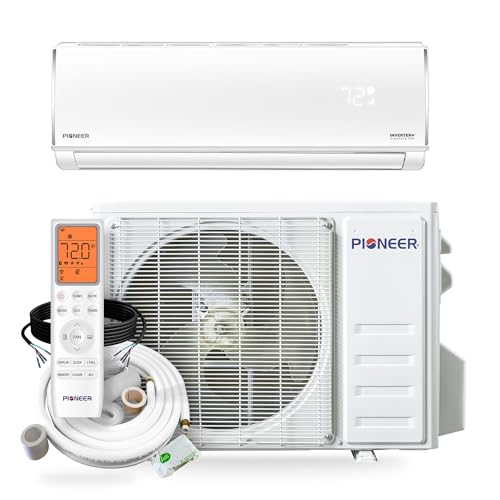
Pioneer Diamante Pro 9000 BTU
Best for: small rooms needing precise remote sensing
- Cooling Capacity
- 9,000 BTU
- Efficiency Rating
- 20.0 SEER2
- Voltage
- 230V
- Coverage Area
- 250 to 350 sq ft
- Number of Zones
- Single Zone
- Heat Pump
- Heat Pump
View on Amazon: Pioneer Diamante Pro 9000 BTU Affiliate link
The Pioneer Diamante Pro is a 9,000 BTU heat pump designed for single-zone spaces up to 350 square feet. It operates on 230V power and delivers 20.0 SEER2 efficiency. The unit includes dual-axis airflow louvers and an I FEEL remote sensor. It runs in heating mode down to -4°F. This model suits small rooms where high efficiency and precise temperature control are priorities.
Pros
- 20.0 SEER2 efficiency rating for part-load operation
- Dual-axis motorized louvers for up-down and left-right airflow
- I FEEL remote sensing for personalized comfort
- Heating capability down to -4°F
Cons
- App control requires a separately sold module
- Lower 9,000 BTU capacity compared to 24,000 BTU options
- Single-zone configuration limits whole-home coverage
Good fit if
- You need efficient cooling for a small room under 350 sq ft
- You want precise temperature control via the I FEEL remote
- You require heating performance in cold climates down to -4°F
Skip if
- You need to cool a large open area requiring 24,000 BTU
- You want built-in Wi-Fi without purchasing extra hardware
- You are looking for a multi-zone system for multiple rooms
Verdict: Pioneer Diamante Pro 9,000 BTU Mini Split fits small rooms needing efficient, quiet cooling and reliable cold-weather heating. It is ideal for users who value precise remote sensing over whole-home coverage.
Specifications side by side
| Spec | Cooper & Hunter 24k BTU 230V Mini Split | Pioneer Diamante Pro 9000 BTU |
|---|---|---|
| Cooling Capacity | 24,000 BTU (2 Ton) | 9,000 BTU |
| Efficiency Rating | 18.7 SEER2 | 20.0 SEER2 |
| Voltage | 230V | 230V |
| Coverage Area | not stated | 250 to 350 sq ft |
| Number of Zones | not stated | Single Zone |
| Heat Pump | Heat Pump | Heat Pump |
| Smart Connectivity | Smartphone app | not stated |
| Mounting Type | not stated | Wall Mount |
| Dimensions | 48 × 40 × 40 inches | 8 × 31.9 × 11.5 inches |
| Weight | 165 pounds | not stated |
| Size | 24,000 BTU, 230V | 250~350 sq ft |
| Color | White | White |
| Model | CH-RLS24MIA-230VI & CH-RLS24MIA-230VO | Diamante |
Frequently asked questions
Can Cooper & Hunter mini splits handle large rooms?
Yes, the Cooper & Hunter 24k BTU 230V Mini Split is designed for large spaces. It delivers high cooling capacity suitable for big areas like garages or open layouts. This unit requires 230V power and includes smart app control for convenient management of your home's temperature.
Is PIONEER good for small bedrooms?
The PIONEER Diamante Pro 9,000 BTU is ideal for small rooms. It covers spaces between 250 and 350 square feet efficiently. This model features precise remote sensing technology, allowing for accurate temperature regulation without the need for whole-home coverage or excessive energy use in smaller areas.
Do these brands use 230V power?
Both featured models operate on 230V power. The Cooper & Hunter 24k BTU unit and the PIONEER Diamante Pro 9,000 BTU both require this voltage. This ensures compatibility with standard residential electrical systems that support higher voltage inputs for efficient inverter technology and heat pump performance.
Which mini split has smart app control?
The Cooper & Hunter 24k BTU 230V Mini Split includes smart app control. This feature allows you to manage the unit remotely via a mobile application. It fits users who want to adjust settings and monitor their large space's climate from anywhere using their connected devices.
What is the size difference between these units?
The Cooper & Hunter unit is significantly larger, measuring 48 inches in length. The PIONEER Diamante Pro is more compact at 8 inches in length. This size difference reflects their respective capacities, with the Cooper & Hunter model built for high-output cooling in expansive areas compared to the smaller PIONEER unit.
Does PIONEER offer remote temperature sensing?
Yes, the PIONEER Diamante Pro 9,000 BTU features precise remote sensing. This technology allows the system to detect temperature variations away from the indoor unit. It ensures consistent comfort in small rooms by adjusting based on actual conditions rather than just the air near the thermostat.